The Double Squeeze: Psychedelic Integration Supply and Demand
Why the people who need integration support after a psychedelic experience struggle to access it, and why the people who could provide it cannot afford to stay.

A few weeks ago, someone posted in r/TherapeuticKetamine that they had just completed a course of infusions for treatment-resistant depression. And for the first few days afterwards they felt great. Clearer-headed, lighter and like something had finally shifted after being stuck for years. But then, gradually, that feeling started to fade and they could not understand why. To them, it felt like their intrusive former thought patterns were returning, leaving them feeling uncertain as to whether this was to be expected or not. Their clinic had not mentioned anything about the importance of integration after their session. So they turned to asking strangers on the internet for advice.
I replied, as I often do on that forum, explaining what the neuroplasticity window is: the two-week period following a ketamine infusion during which the brain is in a heightened state of malleability, receptive to new patterns of thought and behaviour. Research is increasingly clear that this window is where much of the therapeutic work either happens or does not. I suggested journalling with intention, working with a therapist or integration coach if possible, and paying close attention to the psychological material that had surfaced during the infusion sessions.
The Integration Gap: Revisited
In an earlier piece in this series, I wrote about the ketamine integration gap: the disconnect between what ketamine does pharmacologically and what most clinics do to help patients make the most of it. There is ample clinical evidence that structured integration support post-session significantly supports the improved durability of the antidepressant response. However, the clinical reality is that most clinics provide little to none of it. Typically, patients complete a standard course of six infusions over two to three weeks, but outside of those clinic sessions they are largely on their own.
Oregon Health Authority data shows that psilocybin facilitators spend approximately fifteen hours per client across preparation, administration, and integration sessions combined. Those fifteen hours represent a full therapeutic arc that provides close support before, during and after the dosing session. Unfortunately, for the majority of ketamine patients receiving infusion-only treatment, the equivalent figure is close to zero. We will dive deeper into the dynamics that underpin access to integration below.
The sheer volume of lost souls on Reddit alone speaks to how the integration gap in ketamine therapy is indeed real. As a result and out of frustration, desperation or both, people are turning to internet forums in the hope of receiving the advice they need in order to hold on to perhaps the most significant psychological experience of their lives.
Psychedelic therapy is still finding its feet
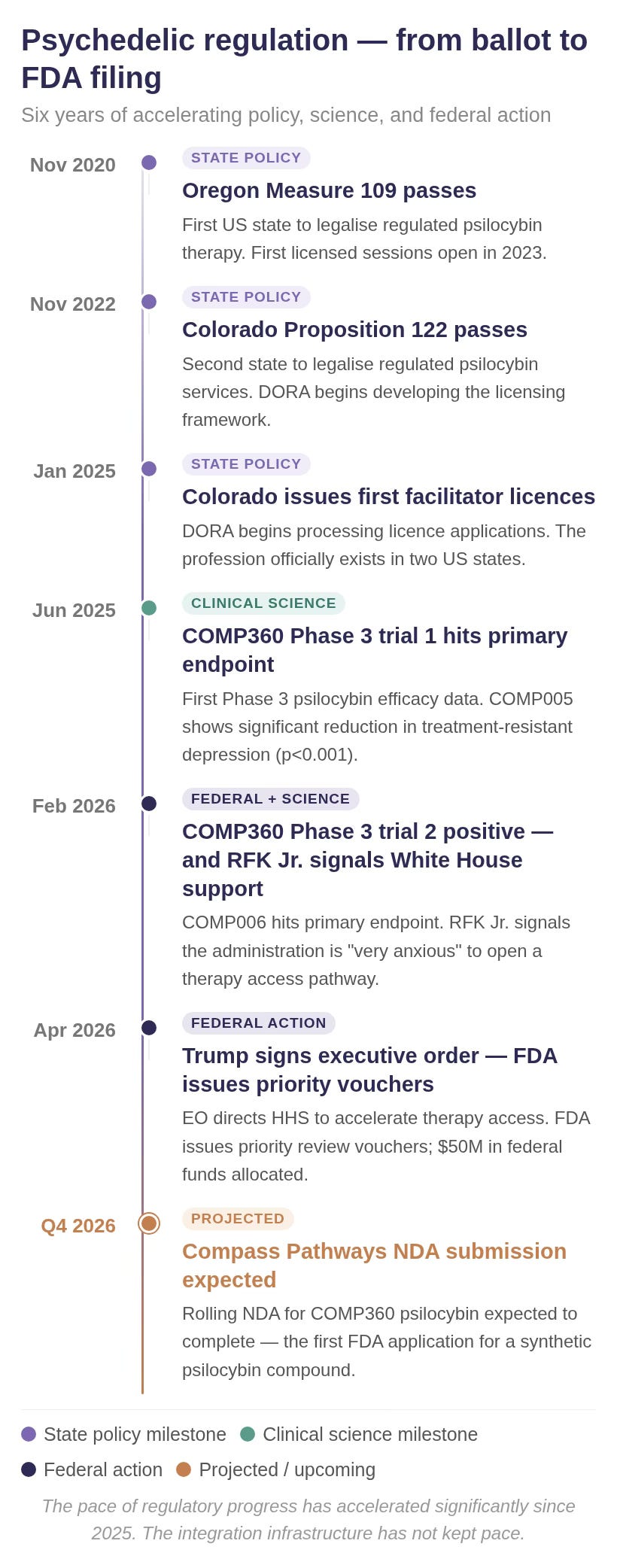
Regulated psilocybin facilitation in the US is really only a few years old and limited to just two states to date. Oregon’s Measure 109 passed in November 2020 and service centres began opening as recently as 2023. Colorado’s Proposition 122 followed in 2022, with DORA beginning to issue facilitator licences in January 2025. Other states are at various stages of building regulated frameworks.
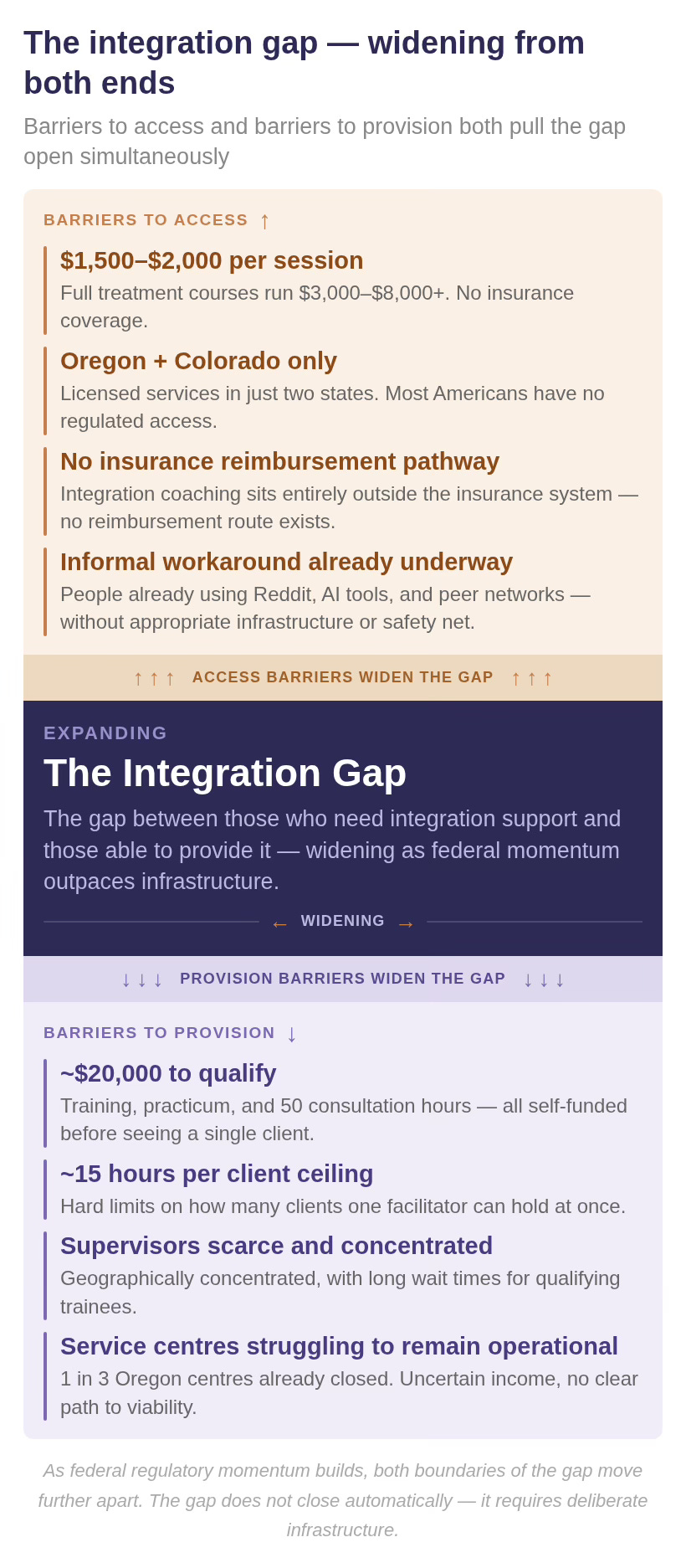
However, the progress that has been made so far is struggling. By early 2026, a third of Oregon’s licensed psilocybin service centres had closed. Of the 35 facilities that received licences, thirteen have shut down, with operators citing economics explicitly: annual facility licensing fees of $10,000, compliance costs, insurance requirements, and a client acquisition rate that had not kept pace with overheads.
Oregon Health Authority figures published in July 2025 showed that psilocybin therapy clients skew significantly wealthier than the general population. The programme is largely only reaching people who can absorb session costs running into several thousand dollars. Importantly, the demographic that carries the heaviest burden of treatment-resistant depression or end-of-life distress are typically of lower financial means. The problem is exacerbated by the fact psilocybin is not (yet) FDA approved, and therefore cannot be reimbursed through health insurance.
The supply side: what it actually costs to become a facilitator
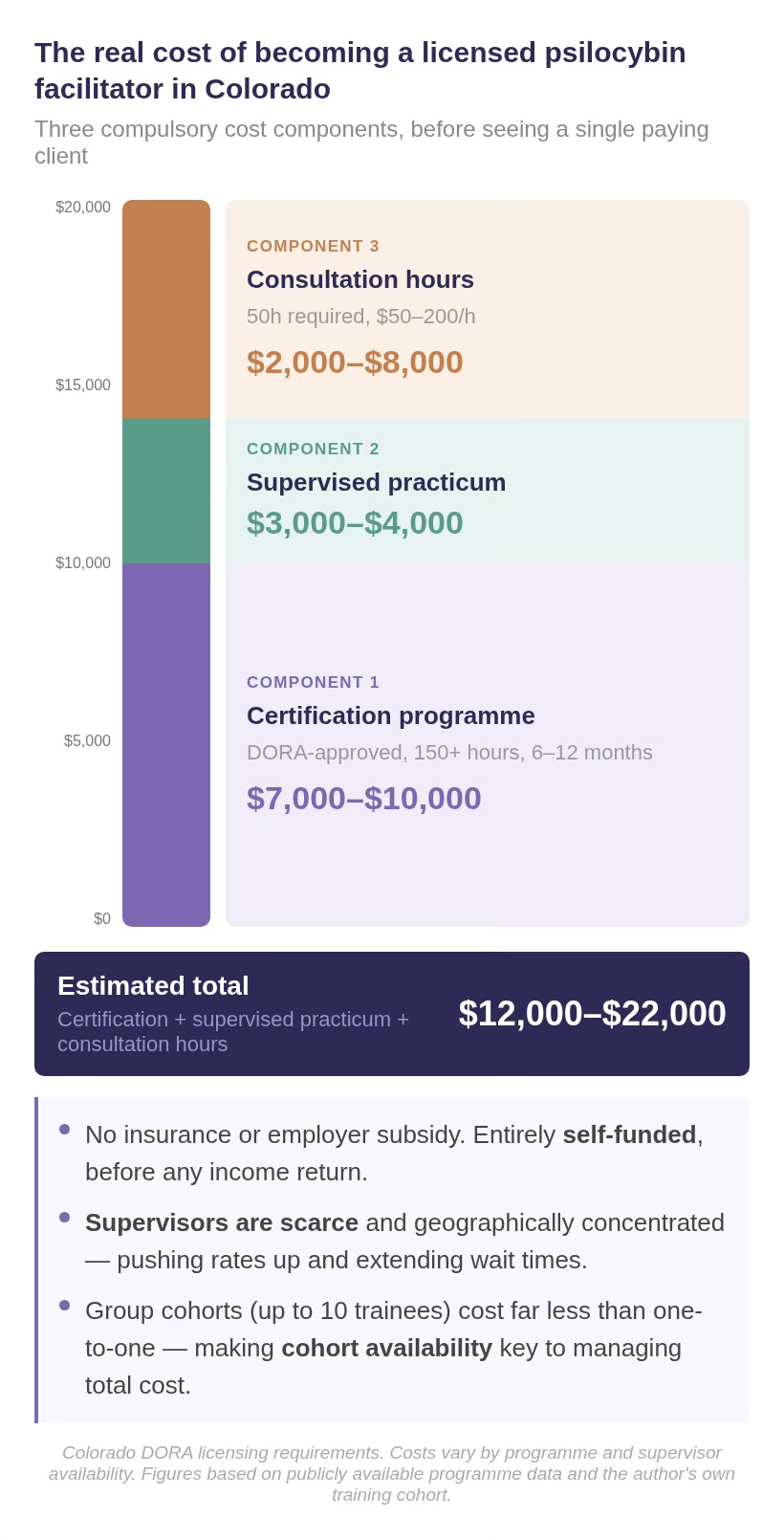
A Colorado DORA-approved facilitator training programme typically costs between $7,000 and $10,000 in course fees alone, running for six to twelve months and involves accruing 150 curriculum hours (including at least double that in assignment and reading hours). In addition, for full licensure one must complete a further 40 hours of supervised practicum training ($3,000–4,000) and 40 hours of consultation hours which run at a cost of $2,000 to $8,000. In total, you are looking at anything between $12,000 to $22,000 for full licensure to practise independently as a facilitator. That figure sits in the context of a profession where income is uncertain, client numbers are still only growing slowly, and there is no established clinical referral infrastructure to support newly qualified individuals.
Oregon data shows facilitators spend approximately fifteen hours per client across the full treatment arc of preparation, administration, and integration. Most practitioners consider managing two to three clients per week as the ceiling for emotionally intensive work of this kind. In practice, due to sluggish demand, facilitators working through service centres are typically seeing only three to five clients per month. Once you deduct service centre fees, monthly earnings are rarely sufficient to constitute a primary income source.
What all this means in practice is that the profession is currently selecting, at least in part, for people who can absorb a significant investment in training on the basis of an uncertain income return. This is not the same as selecting for the people best equipped to do this work. Furthermore, the current economics of facilitator earnings potential does not support the long term growth of this industry.
The demand side: a gap the insurance system does not cover
On the client side of the ledger, the picture is similarly compressed.
A full course of psilocybin-assisted work at a licensed service centre involves typically two or more preparation sessions, the facilitated dosing session, and at minimum one integration session, at a cost of between $1,500 and $2,000 or more out of pocket. Ketamine infusion courses, on the other hand, run from $400 to $800 for the infusions alone, and often much more if any form of integration support is included. None of this is currently covered by health insurance.
Standalone integration coaching faces a similar cost barrier. A skilled integration coach charges between $80 and $200 per session. A meaningful programme of five or six sessions spread over two to three months can therefore cost anywhere from $400 to $1,400, a figure that’s comparable to private therapy but without any of the insurance reimbursement pathways that make private therapy accessible to the broader population.
The cost-of-living pressures of recent years have squeezed both sides of this equation simultaneously: the facilitator, who must recover a substantial training investment against a caseload that has real human limits; and the client, for whom several thousand dollars for a guided experience is a genuinely significant sum.
The demand that is coming
The regulatory roadmap toward broader access to psychedelic therapy has nonetheless developed rapidly. In June 2025, Compass Pathways announced that its COMP360 psilocybin compound had hit the primary endpoint in the first of two Phase 3 trials for treatment-resistant depression, defined as a highly statistically significant reduction in symptom severity. A second Phase 3 trial, COMP006, reported positive results on 17 February 2026. Compass is now completing a rolling NDA submission, expected in Q4 2026. FDA approval of a synthetic psilocybin compound is no longer a future prospect but an active filing process. If approved, it would be the first FDA-sanctioned psychedelic-assisted therapy in history and would open insurance reimbursement pathways that do not currently exist.
On 18 April 2026, President Trump signed an executive order directing the Department of Health and Human Services to accelerate access to treatments for serious mental illness, explicitly including psychedelic-assisted therapies. The FDA acted on it immediately, issuing priority review vouchers to three companies studying psilocybin and methylone, which can compress review timelines from months to weeks. The order also allocated $50 million in federal funds to match state investments in psychedelic research.
In addition, the Department of Veterans Affairs (VA) has funded its first studies on psychedelic-assisted therapy, with trials underway across nine VA facilities to help address the endemic mental health crisis amongst veterans and first responders in the US. Furthermore, the DEA increased psilocybin production quotas to 50,000 grams for 2026, up from 30,000 grams in 2025, reflecting the expanded research pipeline.
RFK Jr., in his role as HHS Secretary, stated in February 2026 that the Trump administration was ‘very anxious’ to create a psychedelic therapy access pathway and wanted to get it to the public ‘as quickly as possible.’
What this means is that the client population for psychedelic-assisted work is likely to grow substantially over the next two to three years. The mental health crisis has only deepened. The integration infrastructure to serve this demand has not grown at anything like the same pace.
What the field needs to move forward
None of the above is an argument that facilitated psilocybin work should be cheaper than it is. The costs reflect real expenses: trained practitioners, licensed facilities, supervision, insurance, and the time and emotional investment the work genuinely requires. Making the model cheaper would not improve access, but instead degrade the quality and safety that make it worth accessing in the first place.
What it is an argument for, is a broader range of support models sitting alongside the flagship facilitated experience. Models that can reach the person in r/TherapeuticKetamine who is watching their neuroplasticity window close and does not know what to do, and models that do not require expensive integration session fees or a postcode in Portland or Denver.
Integration circles, consisting of facilitated group settings for people processing psychedelic experiences, offer one alternative pathway. The cost per participant is substantially lower than one-to-one coaching, and the peer dimension adds something individual sessions cannot replicate. Online delivery extends the reach further.
And then there is the question of digital tools. The person I messaged on Reddit, and the dozens of others in threads like it, are already seeking informal support from whatever is available. Some are using general AI assistants such as ChatGPT, with varying degrees of success. This is understandable: the need is real, the access barriers are real, and a general-purpose AI is free and available at any hour when the material is most present.
However, the limitations of general AI chatbots in this context are real. They are not trained on the nuances of psychedelic experience. They have no persistent memory across sessions. And when integration touches on emotional instability or crisis, they are not reliably equipped to recognise or respond to those cues safely and consistently.
What that gap points to is not a problem with digital tools in principle, but a clear description of what a purpose-built integration tool would need to do. The technology to build this well now exists, and is something I am paying close personal attention to, for reasons that will become clearer in the coming weeks.
Where are we now?
The person in r/TherapeuticKetamine who asked how to hold on to the window their infusions had opened was not asking an unusual question. They were indeed asking the question that thousands of people are asking every week, and the answer they needed is not complicated. What was missing was not the knowledge, but the accessible, affordable, persistent support structure that should have been there to provide it.
The integration gap is being squeezed from both ends. The people who need support cannot easily access it. The people trained to provide it are navigating a pricey entry cost into a profession whose economics remain genuinely uncertain for many. These are not unrelated problems, but the same problem seen from different angles.
The consultation hour bottleneck is solvable. The supervisor shortage is solvable. The access barriers are partially solvable, with the right combination of peer support, online delivery, and carefully designed digital infrastructure. None of these solutions exists yet at a meaningful scale but all of them are being worked on, by people who understand what is at stake.
Further Reading
[1] Dore, J. et al. (2019). Ketamine Assisted Psychotherapy (KAP): Patient Demographics, Clinical Data and Outcomes in Three Large Practices Administering Ketamine with Psychotherapy. Journal of Psychoactive Drugs, 51(2), 189–198
[2] Wilkinson, S.T. et al. (2018). The effect of a single dose of intravenous ketamine on suicidal ideation: a systematic review and individual participant data meta-analysis. American Journal of Psychiatry, 175(2), 150–158
[3] Oregon Health Authority (2025). Oregon Psilocybin Services — Programme Data. OHA/PH/Prevention & Wellness
[4] Redden, M. (2025, June 3). Oregon’s Psychedelic Service Centers Are Closing Amid High Costs and Tough Regulation. Willamette Week
[5] OPB News (2026, January 22). A third of Oregon’s licensed psilocybin service centers have closed. Oregon Public Broadcasting
[6] Bernstein, M. (2025, July 3). Oregon psilocybin therapy clients tend to be wealthier, new data suggests. Oregon Public Broadcasting
[7] Compass Pathways (2025, June). Compass Pathways Successfully Achieves Primary Endpoint in First Phase 3 Trial Evaluating COMP360 Psilocybin for Treatment-Resistant Depression. Investor Relations Press Release
[8] Compass Pathways (2026, February 17). Compass Pathways Successfully Achieves Primary Endpoint in Second Phase 3 Trial Evaluating COMP360 Psilocybin for Treatment-Resistant Depression. Investor Relations Press Release
[9] The White House (2026, April 18). Executive Order: Accelerating Medical Treatments for Serious Mental Illness. whitehouse.gov
[10] NBC News (2026, April 24). FDA grants quick review for 3 psychedelic drug trials — psilocybin and methylone. NBC News
[11] US Department of Veterans Affairs (2024). VA funds first study on psychedelic-assisted therapy for Veterans. VA Press Release, news.va.gov
[12] US Drug Enforcement Administration (2026, January 5). Established Aggregate Production Quotas for Schedule I and II Controlled Substances for 2026. Federal Register
[13] Kennedy, R.F. Jr. (2026, February 27). Trump Administration ‘Very Anxious’ To Allow Psychedelic Therapy ‘As Quickly As Possible,’ RFK Tells Joe Rogan. Marijuana Moment (reporting on The Joe Rogan Experience, Episode 2461)